El silencio no existe
Los renglones torcidos de DiosEl silencio no existe is the proposition Alice Gould develops when an examining physician asks whether she likes silence. Her answer overturns the premise of the question: what people call silence is not an absence of sound but a label for sounds too faint, unfamiliar, or numerous to identify. She moves from the city to the forest and then to the universe, arguing that every apparent quiet contains sound—and that sound, once produced, does not simply vanish. The exchange makes an ordinary clinical question the occasion for a sustained account of what can be heard, what goes unnoticed, and what the word silence claims to describe.
From a brief answer to an argument
The physician first asks whether Alice likes silence. She replies that silence does not exist, then agrees to develop the claim. Her response begins by challenging a familiar complaint: people say that human beings have killed silence, but Alice considers this unfair. Leaving a noisy city does not deliver silence; it exchanges one set of sounds for another. The opposition between city and refuge therefore fails to establish the opposition between noise and its absence. A quieter place changes what is heard, not whether anything is heard.
Alice presents the point as a correction to ordinary speech rather than as a claim of originality. Later she calls what she is saying simple and not original, because, in her account, it has been demonstrated. That qualification matters to the argument’s manner: she does not frame silence as a mystery she alone can penetrate, but as an error hidden in a familiar word. The phrase El silencio no existe compresses her conclusion into a blunt assertion; the explanation then takes apart the everyday assumption that the phrase seems to deny.
Solitude and the sounds people overlook
The physician suggests that complete solitude comes close to silence. Alice rejects even this nearer approximation. A remote forest, with calm air and no brook, birds, or insects, is not acoustically empty: even when the treetops are still, there remains an indefinable, undecipherable pulse. People say they hear silence in such circumstances, she argues, because they cannot identify what they hear. Something is heard; silence itself, by contrast, is inaudible.
This distinction lets Alice preserve the experience that the word silence usually names without accepting the word as a literal description. Quiet can be real as an impression, but it is not proof that sound has stopped. The forest scene sharpens the argument because it strips away the obvious sources of noise one by one. With no stream nearby, no birds, no insects, and motionless crowns of trees, the remaining sound resists recognition. It is precisely that failure to decipher the sound, rather than a genuine void, that produces the impression of silence.
Alice also describes silence as a human invention: a word for a reality people have never experienced. In her account, both the person and the world around them consist of accumulations of minute noises. The term gives a name to an absence that perception never actually encounters. Her reasoning turns on a small but consequential difference: not hearing a distinct sound is not the same as hearing nothing. Solitude may remove company and familiar commotion, yet it does not remove the world’s barely discernible activity.
Sound beyond the present moment
Alice extends the argument from faint sounds to sounds that outlast their original occasion. A sound wave spreads and recedes, she says, but remains eternally. She applies that claim directly to the conversation underway: the exchange with the physician will exist somewhere distant in the future. The claim gives the present scene an unexpected scale. Their conversation is not simply a moment that ends when they stop speaking; in Alice’s account, it joins a continuing history of sound.
She then invokes instruments built to extend human perception. Telescopes allow people to see beyond the reach of unaided sight; radio telescopes, she says, are great ears for catching the noises of the universe. The comparison makes the argument tangible: just as sight’s ordinary limit does not mark the limit of what exists, the ear’s failure to register a sound does not establish silence. Alice says she has read that the dull clamor of the first explosion can still be heard, associating it with the creation of the world and the flight of the galaxies. She sets this cosmic sound against the only silence her account allows: the silence that existed before that beginning. It ended with the first explosion.
The exchange and its changing scale
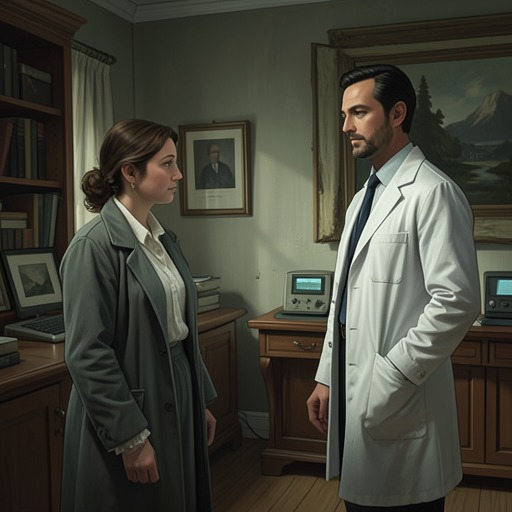
The conversation’s form mirrors the expansion of Alice’s claim. A short question about personal preference becomes a discussion of the city, a forest, persistent sound, scientific instruments, and cosmic origins. Alice initially speaks with a distracted, distant air, but the physician tells her not to interrupt herself, admitting that he is absorbed in listening. His response registers the effect of her explanation within the scene: what began as a question in a consultation has become a performance that holds the listener’s attention.
At the end of the cosmic argument, Alice insists that she will speak no more, then says the physician has forced her to express herself in an authoritative, lecture-like manner. The ending preserves a tension between reluctance and elaboration. She disclaims originality and professes to stop, yet has carried the discussion from an everyday impression to the first explosion and the distant survival of a conversation. El silencio no existe thus works both as her claim about the world and as the organizing principle of her speech: each apparent boundary—between city and solitude, quiet and sound, a voice and its disappearance—opens onto something that continues beyond it.